
Jeanne is struggling to make ends meet. Her rent, groceries, tuition—the bills are piling up. She’s worried she’ll have to drop out of college. Between her full-time studies and her job, she’s working 65-hour weeks. Yet she thought she’d be eligible for some form of government assistance so she wouldn’t have to work such long hours and neglect her studies.
The catch? The government believes Jeanne should be receiving support from her parents, which isn’t the case. As a result, she finds herself in a bind. Without government or parental support, Jeanne faces heart-wrenching choices. But is this what we want for students in Quebec?
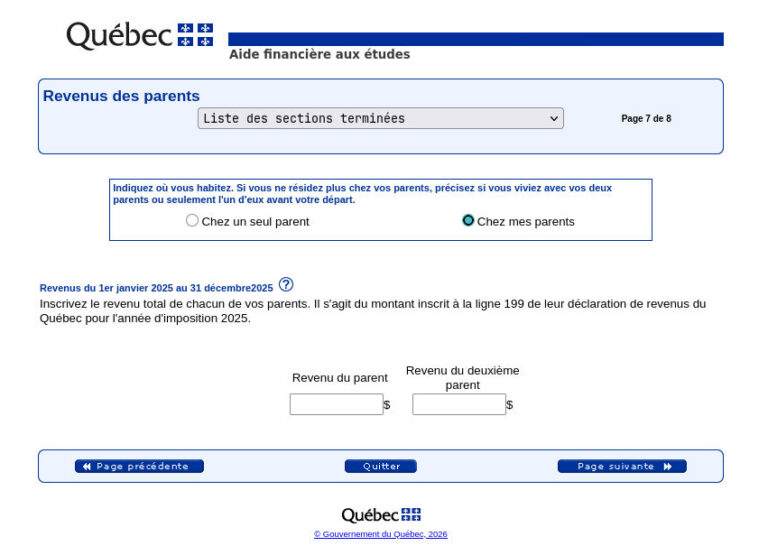
In fact, the parental contribution represents the financial support we should receive from our parents. It is a legal obligation. The government assumes that the parental contribution is paid to students, and the higher the parents’ income, the larger this contribution is. The larger it is, the smaller the government’s financial aid for education.
Let’s consider the following scenario: the government estimates that a student needs $1,500 per month to live on while in school. Based on her parents’ income, it assumes that they should contribute $500 per month to financially support their daughter during her studies. In this case, the government will provide $1,000 per month in loans and grants to the student, regardless of whether she actually receives $500 per month from her parents. The parental contribution is included in the AFE calculation for all individuals considered financially dependent on their parents and whose parents earn more than $75,000 combined.
The AFE is supposed to help us become more independent from financial pressures during our studies. However, the weight given to parental contributions in the AFE calculation places students in another form of dependency: financial dependence on their parents. The government assumes that our parents are obligated to provide this contribution, but obtaining it is not always easy. Often, receiving it comes with judgments and conditions, expectations regarding academic performance, restrictions on acceptable programs of study, or pressure regarding life choices. While the AFE should ensure the freedom to choose our studies without fear of financial insecurity or pressure from those around us, the parental contribution places us in a position of dependence on our parents.
This dependency makes it much harder to leave toxic and abusive family environments, which disproportionately affects queer people1, especially when one considers that one of the most realistic ways to escape parental support is marriage.
If our parents fail to provide the expected financial support, the only solution the government offers is to sue them to force them to give us the money. As if students who are struggling to make ends meet had the time and money to file a civil lawsuit—or even the willingness to take steps that risk straining their relationship with their parents. For those dependent on parental contributions, the dilemma is therefore whether to accept the control their parents have over their lives, to expend effort and resources to destroy their relationship with their parents by suing them, or, ultimately, to find a way to no longer be considered financially dependent on their parents, so that the parental contribution is excluded from the AFE calculation.
So, we have three main options available to us.
The first is to start one’s own family, either by having children or getting married. Indeed, what better way to escape the grip of one’s family than to start a new one! Parental contributions make the AFE a tool of control, reinforcing the family’s power by maintaining parental control and offering the establishment of one’s own family as the primary way out, thereby encouraging new generations to conform to the nuclear family model.
Otherwise, you can take a two-year break from school to work. This means you have to enter the workforce, putting your education on hold. Returning to school is often more difficult, especially after two years in the workforce. The idea of forcing a break from studies in order to gain access to education is rather absurd. This measure aims to encourage a return to school, but it does not offer a real solution for people who want to continue their studies.
Ultimately, you may be able to find a social worker who can attest that your family situation has deteriorated to such an extent that you had to leave your family home or cut off contact with your parents. Even without considering the difficulty of accessing a social worker, this means that the only family relationships that warrant having the parental contribution removed are those that have completely broken down.
Access to student financial aid should not depend on the goodwill of parents. That is why we believe that removing the parental contribution from the calculation of financial aid should be part of a reform of the AFE.
Following the elimination of the parental contribution, how can we ensure that wealthier parents pay their fair share? In the same way that we must ensure that the wealthiest individuals in general pay their fair share—by ensuring that our public services are funded in a way that redistributes wealth, whether through a progressive income tax, a tax on large private corporations, or a tax on fixed capital.
This is why CRUES is calling for the elimination of the parental contribution as part of its proposals to reform the AFE, as well as for the reform to be funded through tax increases on the wealthiest individuals.
- On this issue, you can read the following :
McDermott, E., Gabb, J., Eastham, R. et Hanbury, A. (2021). Family trouble: Heteronormativity, emotion work and queer youth mental health. Health, 25(2), 177‑195.https://doi.org/10.1177/1363459319860572
Schmitz, R. M. et Tyler, K. A. (2018). The Complexity of Family Reactions to Identity among Homeless and College Lesbian, Gay, Bisexual, Transgender, and Queer Young Adults. Archives of Sexual Behavior, 47(4), 1195‑1207.https://doi.org/10.1007/s10508-017-1014-5 ↩︎